
The Saudi Car Wash Market Is Shifting Toward Automation — Here’s What Investors Need to Know
Saudi Arabia is one of the most vehicle-dense markets in the world. With over 15.8 million registered cars on the road as of 2024, demand for professional car washing services has never been stronger — and a landmark regulatory change in 2024 has permanently altered how this business operates.
For anyone planning to invest in a car wash, understanding the new rules isn’t optional. A decision by the Permanent Executive Committee for Service Centres and Fuel Stations effectively banned manual car washes inside fuel stations, mandating that all car wash operations co-located with fuel stations must now be fully automatic.
This single shift has created a major window of opportunity for automatic car wash equipment buyers — and a critical need for reliable, service-backed machinery.
New 2024 Regulations: What Changed and Who Is Affected
The regulatory update that took effect in 2024 applies specifically to car washes operating within fuel station premises. The key points:
- Manual car washes are no longer permitted inside fuel stations. Any existing manual operation must transition to an automated system within a 12-month corrective window from the date of the regulation.
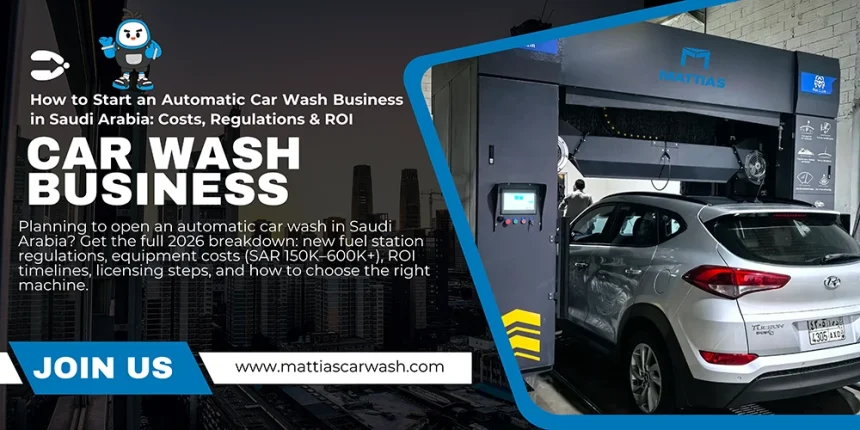
- Only mechanical automatic systems — either roll-over (in-bay) or tunnel configurations — are now approved for fuel station installations.
- Space and installation must follow manufacturer specifications. Equipment footprint, drainage engineering, and layout must comply with both the machine manufacturer’s guidelines and municipal approval.
Important clarification: If your car wash is located independently — in a commercial area, a tyre shop, a service centre, or a standalone site — you are not required to go automatic. The mandate applies only within fuel station boundaries. That said, independent operators who are considering automation will benefit from the same commercial advantages: higher throughput, reduced labour dependency, and increasingly, customer preference for contactless washing.
Environmental Compliance Is Now Mandatory
Alongside the automation mandate, environmental requirements have been tightened across all car wash types:
- Wastewater cannot be discharged directly into the public sewage network without passing through a treatment system.
- Flooring must include proper drainage slopes, oil-water separators, and grease traps.
- Where municipal sewage infrastructure is absent, a self-contained local sewage system must be installed.
These requirements affect equipment selection directly — your site preparation costs and drainage engineering must be factored into the total setup budget.

Types of Automatic Car Wash Systems: Which Is Right for Your Site?
Roll-Over (In-Bay) Automatic System
The car parks in a fixed position while the machine travels around it. This is the more compact option:
- Footprint: Minimum 80 m², ideal 100–150 m²
- Throughput: 6–15 cars per hour depending on wash cycle settings
- Best for: Fuel stations, tyre shops, small-footprint commercial sites, dealerships
- Investment range: SAR 150,000–400,000
The Mattias M-WS310 and M-WS210 are roll-over models designed for exactly these environments — built to Chinese manufacturing cost efficiencies but tested to the throughput and reliability standards that fuel station operators require.
Tunnel System
The car is conveyed through a fixed washing tunnel on a belt or roller system. High-volume option:
- Footprint: Minimum 200 m², ideal 300–500 m² with 20+ metre tunnel length
- Throughput: 50–60 cars per hour (full tunnel)
- Best for: High-traffic standalone sites, shopping mall car parks, highway service areas
- Investment range: SAR 600,000–1,000,000+
The Mattias M-LM216 and M-LM535 serve this segment, offering full-tunnel configurations with adjustable wash programmes suited to the Saudi dust-heavy environment.
What Does an Automatic Car Wash Actually Cost in Saudi Arabia?
Here is a realistic cost picture for an automatic system in 2025, based on current market conditions:
Capital Costs (Roll-Over System — Example)
| Item | Estimated Cost (SAR) |
|---|---|
| Automatic car wash machine (roll-over) | 150,000–350,000 |
| Site preparation: drainage, flooring, electrical | 20,000–50,000 |
| One year advance rent (commercial location) | 40,000–120,000 |
| Permits and licensing (commercial reg + municipality + civil defence) | 5,000–8,000 |
| Signage and finishing | 5,000–15,000 |
| Total estimated setup | ~220,000–540,000 |
Monthly Operating Costs (Roll-Over, 1–2 Operators)
| Item | Estimated Cost (SAR/month) |
|---|---|
| Rent | 3,500–10,000 |
| Labour (1–2 supervisors/operators) | 4,000–6,000 |
| Utilities (electricity + water) | 2,000–4,000 |
| Chemicals and consumables | 2,000–3,000 |
| Maintenance reserve | 1,000–2,000 |
| Total monthly operating | ~12,500–25,000 |
Revenue Model (Roll-Over, Moderate Traffic)
Based on a conservative 30 cars per day at an average ticket of SAR 40:
- Daily revenue: SAR 1,200
- Monthly revenue (26 operating days): SAR 31,200
- Monthly net profit (after ~SAR 16,000 costs): ~SAR 15,000
- Payback period on equipment: approximately 10–20 months
Automatic systems significantly outperform manual operations in labour efficiency. A fully automated rollover machine can be operated by one attendant, compared to 3–5 workers in a manual wash of equivalent volume.
Licensing Steps: How to Legally Open a Car Wash in Saudi Arabia
Step 1 — Commercial Registration (Ministry of Commerce)
Register your business activity under “car washing and lubrication.” Registration is done through the Ministry of Commerce website. Annual cost: SAR 200 plus Chamber of Commerce fees. Registration period: 1–5 years.
Step 2 — Municipal Commercial Activity License (Balady Platform)
Submit a new commercial activity licence application through the Balady electronic platform. Required documents include your national ID or residency document, commercial registration, lease or ownership deed, and a site layout. After municipal inspection, the licence is issued at SAR 1,000–3,000 depending on location and area.
Step 3 — Civil Defence Safety Certificate (Salamah Portal)
A mandatory safety inspection covers fire extinguisher placement, alarm systems, emergency exits, and safety signage.
Step 4 — Environmental Permit (where applicable)
Some municipal jurisdictions require a separate environmental clearance for water treatment systems and waste disposal. Confirm requirements with your local municipality before breaking ground.
Step 5 — SABER Product Certification for Imported Equipment
If you are importing automatic car wash equipment from outside Saudi Arabia — including from China — the machinery must pass SASO conformity assessment and receive SABER certification before it can legally be installed and operated. This is a critical step many first-time importers overlook.
Reputable equipment suppliers, including Mattias CarWash, can provide the technical documentation and compliance certificates (CE marking, ISO, product test reports) required to support your SABER application.

Choosing the Right Equipment Supplier: What Saudi Operators Should Evaluate
The Saudi market currently sees equipment from several major origins:
| Origin | Price Range | Key Consideration |
|---|---|---|
| Germany (WashTec, Christ) | Very high | Best-in-class quality; long lead times; high parts costs |
| Spain (Istobal) | High | European quality; regional distributor presence |
| China (Risense, Mattias) | Competitive | Strong value-for-money; critical to verify after-sales support |
For buyers evaluating Chinese manufacturers specifically, the following should be confirmed before purchase:
1. Local service agent or certified technician presence in Saudi Arabia. Downtime on an automatic machine that runs 40–60 cars per day is a direct revenue loss. Know who services your machine and how fast they can reach your site.
2. Spare parts availability. Standard wear components — brushes, nozzles, sensors, conveyor rollers — should be available locally or with a guaranteed delivery window under 5 business days.
3. SABER documentation support. Your supplier should be able to provide a test report, conformity certificate, and technical file in a format acceptable to the SASO-approved certification body you work with.
4. Wash programme flexibility. Saudi roads generate a distinctive mix of fine dust (particularly in central and northern regions) and oil road film. Confirm whether the machine’s wash programmes can be calibrated for pre-soak dwell time and high-pressure rinse cycles appropriate to local conditions.
5. Water consumption specification. Water costs are a real operational variable in Saudi Arabia. Confirm the machine’s per-cycle water usage and whether a water recycling module is available.
Profitability Outlook: Automatic vs. Manual Car Wash in Saudi Arabia
| Factor | Manual (3–5 workers) | Automatic Roll-Over |
|---|---|---|
| Cars washed per hour | 3–6 | 6–15 |
| Labour cost (monthly) | SAR 9,000–15,000 | SAR 4,000–6,000 |
| Consistency of wash quality | Variable | Consistent |
| Regulatory status in fuel stations | Prohibited | Permitted |
| Setup cost | SAR 80,000–150,000 | SAR 220,000–540,000 |
| ROI timeline | 6–10 months | 10–20 months |
| 5-year total profitability | Lower (labour escalation) | Higher (fixed cost base) |
The ROI timeline for automatic systems is longer upfront, but the 5-year profit curve is typically stronger — particularly as Saudi labour regulations tighten and Nitaqat compliance costs for manual operations increase.
FAQ: Automatic Car Wash Business in Saudi Arabia
Can I still open a manual car wash in Saudi Arabia?
Yes — in independent commercial locations, manual washes remain legal. The ban applies only to car washes operating inside fuel station premises.
How much does an automatic car wash machine cost in Saudi Arabia?
Roll-over systems range from SAR 150,000 to SAR 400,000. Tunnel systems start at SAR 600,000 and can exceed SAR 1 million for high-capacity configurations.
Do I need SABER certification for imported car wash equipment?
Yes. Any car wash machinery imported into Saudi Arabia for commercial use must comply with SASO technical regulations and receive SABER certification prior to installation.
How many cars can an automatic roll-over wash per day?
A typical roll-over system at a well-located site can process 60–120 cars per day, depending on traffic flow and operating hours.
What space do I need for an automatic car wash in Saudi Arabia?
A minimum of 80 m² for a roll-over system (with vehicle queuing space), and a minimum of 200 m² for a tunnel system. Municipal regulations require at least one parking space per 50 m² of wash area, with a minimum of two dedicated spaces.
Can a non-Saudi national own a car wash business?
Yes. Saudi residents holding valid residency can obtain commercial registration and municipal licences for car wash operations, subject to meeting standard licensing requirements.
What is the monthly profit from an automatic car wash in Saudi Arabia?
Estimates for a moderately busy roll-over operation range from SAR 12,000 to SAR 20,000 net monthly profit, based on 30–60 cars per day at SAR 35–50 per wash.
Ready to Explore Automatic Car Wash Equipment for the Saudi Market?
Mattias CarWash manufactures fully automatic rollover car wash equipment and tunnel car wash systems designed for commercial operations across the Middle East. Our equipment has been deployed at fuel stations, tyre service centres, automotive dealerships, and fleet wash facilities across the region.
We support importers and investors with:
- SABER-compatible technical documentation and certification files
- Machine configurations calibrated for Saudi Arabia’s climate and dust conditions
- Remote diagnostics and regional service coordination
- Flexible payment and CIF delivery terms to Saudi ports
Contact our export team to request specifications, pricing, or a site feasibility consultation.